Case study · Full-stack / Client website
Tempo Transport
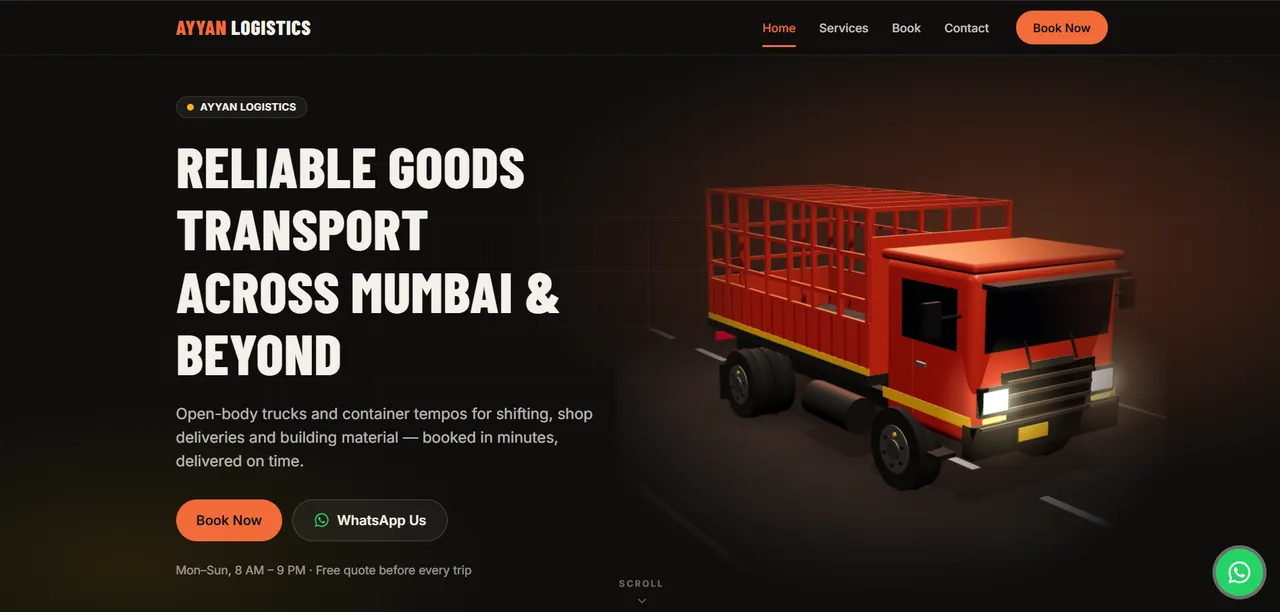
A full-stack website for a goods-transport service covering Mumbai, Thane and Bhiwandi, with outstation trips to Lonavala and Pune. Built with Next.js and Supabase, it has a scroll-driven 3D truck in the hero, online booking and an admin panel.
- Next.js
- React
- Tailwind CSS
- React Three Fiber
- Three.js
- Drei
- GSAP
- Framer Motion
- PostgreSQL
- Supabase
- Resend
- Vercel
$ cat problem.md
The problem
The site had to show customers the fleet, the goods it moves and the areas it serves, so they could pick the right vehicle: a 4-ton open-body truck or a 700 kg container tempo. Booking had to work online, by phone or on WhatsApp, with every booking reaching the business instantly. The business also needed an admin panel behind a secure login.
$ ls ./features
What I built
Website
- Fleet, goods-moved and service-area sections, plus a three-step request → quote → delivery process.
- A rotating, scroll-driven 3D truck in the hero, built with React Three Fiber and Drei.
- Scroll animations with GSAP ScrollTrigger, and page transitions with Framer Motion.
Booking
- Online booking, plus call and WhatsApp click-to-chat.
- Booking emails sent through Resend, so each booking reaches the business instantly.
- Next.js API routes as the backend.
Admin and data
- A complete admin panel with Supabase Auth login.
- PostgreSQL on Supabase as the database.
- Truck photos and documents kept in Supabase Storage.
$ git log --decisions
Decisions
- 01
Backend in Next.js API routes.
Frontend and backend live in one Next.js app, deployed together on Vercel.
- 02
Supabase for database, auth and storage.
Booking data, the admin login, and truck photos and documents all sit on one platform.
- 03
Two channels for every booking.
Each booking reaches the business instantly, through WhatsApp click-to-chat and through email via Resend.
- 04
Auto-deployed from GitHub.
Pushes deploy the site to Vercel automatically; the database runs on Supabase.